


Anyone who has spent a summer afternoon on a busy beach has seen a banner plane drone past. Most of them trail a phone number. Fewer planners have seen a large branded kite holding its position over the sand for an entire afternoon. Both formats put a message in the sky above coastal audiences, and planners file both under aerial advertising. Inside a media plan, though, kite banners vs. airplane banners turn out to be two very different tools.
That difference is why the question comes up so often with OOH planners and brand teams building summer, spring break, or event campaigns. One format covers distance. The other holds a location. The right choice depends on what the campaign needs to accomplish, which beaches matter, how long the audience stays put, and how the operator will document the activation afterward.
This guide compares the two on reach, dwell time, creative, weather, regulation, and proof of performance. It also shows where each one fits in a broader OOH or integrated media plan. We wrote it for media planners and brand marketers who want a clear basis for the recommendation, not a sales pitch.
In This Article:
- Two aerial formats built for different jobs
- How airplane banner advertising works
- How kite banner advertising works
- Kite banners vs. airplane banners on reach, dwell time, and frequency
- Creative considerations for each format
- Weather, regulations, and operating limits
- Proof of performance and campaign documentation
- Where each format fits in an integrated media plan
- How to decide on kite banners vs. airplane banners for your campaign
Two aerial formats built for different jobs
Media plans tend to treat aerial advertising as one line item. A planner wants “something in the sky over the beach,” and the conversation moves straight to availability and budget. That shortcut hides the most important planning variable, which is how the message moves relative to the audience.
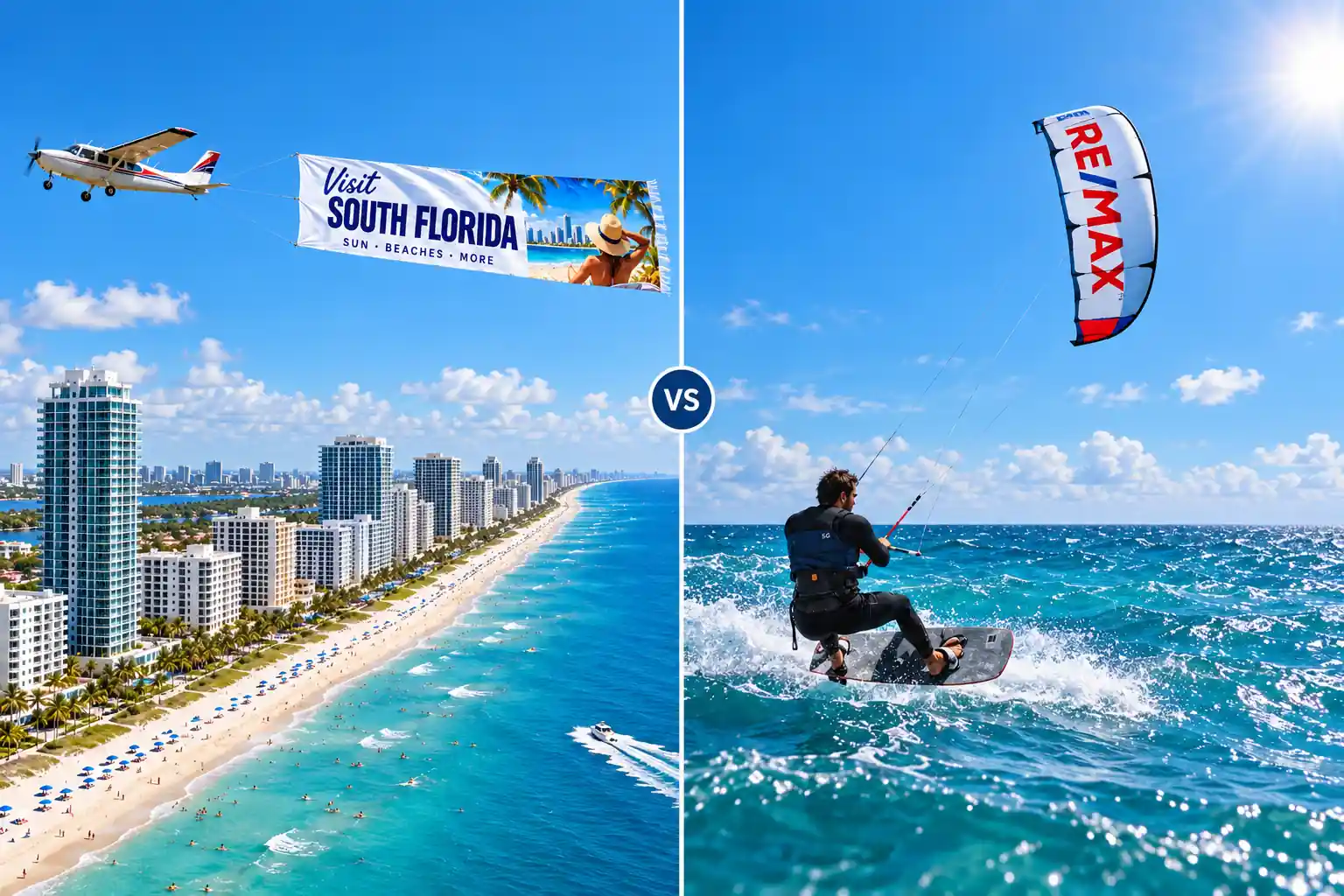
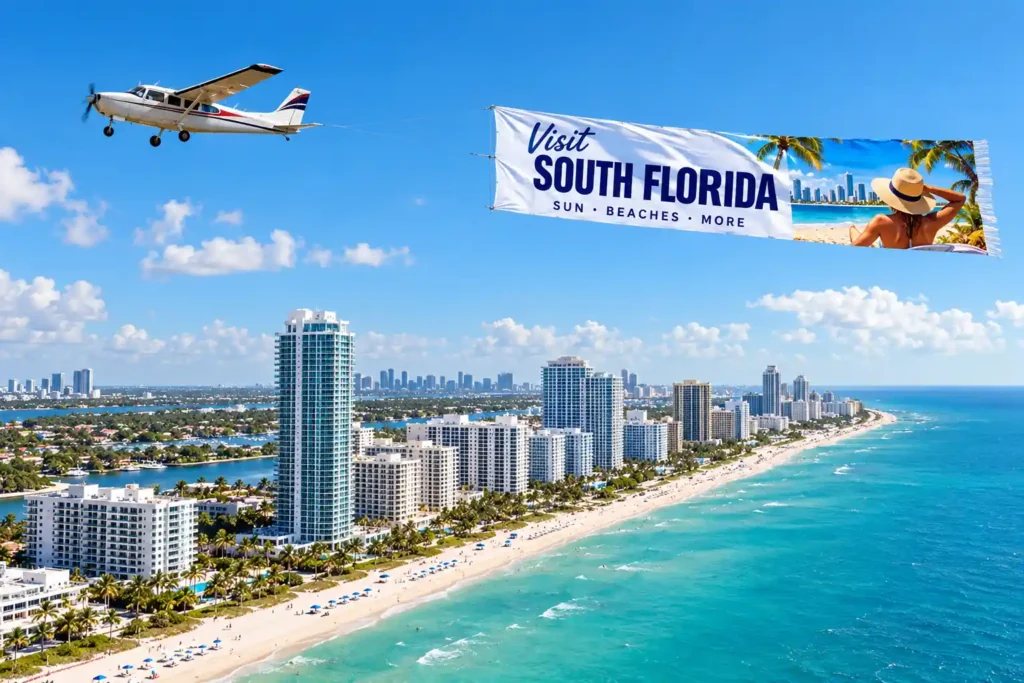
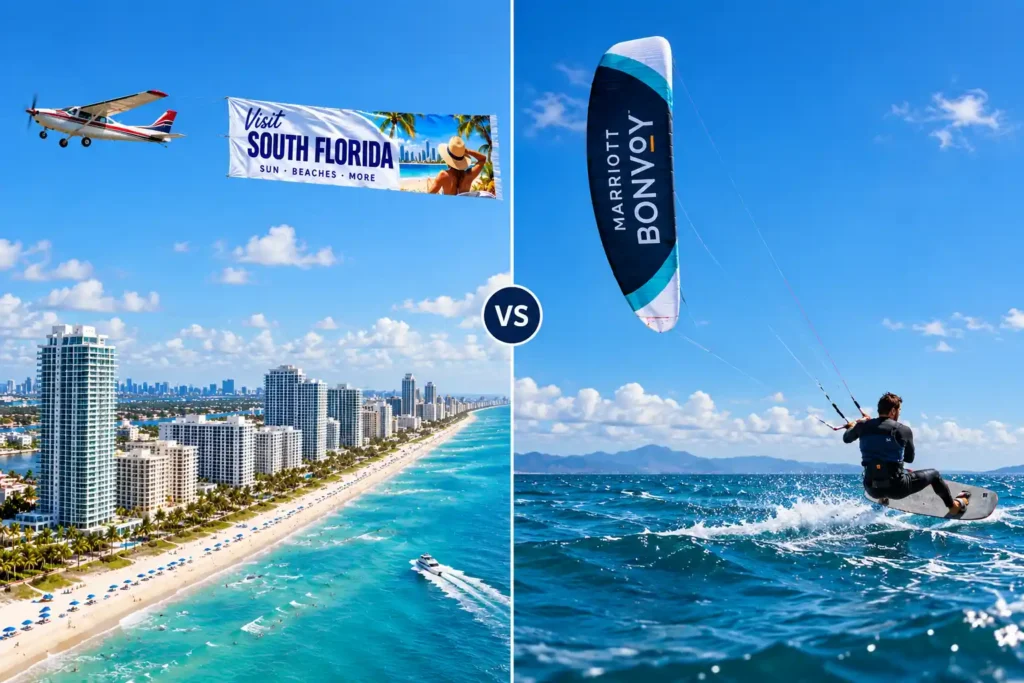
A towed airplane banner is a moving message. It travels along the shoreline, passes over a stretch of beach, and continues to the next one. Its value comes from covering many miles of coastline in a single flight.
A kite banner, however, is a stationary message. It is flown from a fixed point on the beach and stays over the same audience for the length of the activation. Its value comes from persistence over a specific location where people have already settled in for hours.
Of course, neither model is better in the abstract. A regional insurance carrier wants to reach every beachgoer along a county coastline on a holiday weekend. A hotel brand wants guests and day visitors in front of its property to see the same message all afternoon. Those are different problems. Framing the decision this way, as coverage versus presence, makes the rest of the comparison much easier to work through.
How airplane banner advertising works
Banner towing has been part of beach advertising in the United States for generations, and in many coastal markets it is the format people picture first when they hear the phrase aerial advertising. A small fixed wing aircraft picks up a banner after takeoff and tows it along a planned route, usually parallel to the shoreline so the message is readable from the sand.
Because towing anything behind a civil aircraft is a special flight operation, the FAA regulates it at the federal level. Under 14 CFR 91.311, a pilot may tow an object only under the terms of a certificate of waiver issued by the FAA. Established banner tow operators hold those waivers and plan their routes around airspace restrictions, altitude rules, and local conditions.
Banner styles
Most tow operators offer two broad styles. Crews assemble letter banners from individual characters, and they work best for a short phrase, a brand name, or a web address. Billboard style banners are large printed graphics that can carry a logo, imagery, and brand colors. Billboard banners give a creative team more control over the look of the message, while letter banners are usually faster to produce and change.
Where the format is strong
The airplane banner’s biggest advantage is linear coverage. A single route can pass over a long stretch of coastline. That suits broad awareness goals when the audience is spread across many beaches on a peak weekend or holiday. It also suits short, punchy calls to action: a radio station, an event date, a promotion code.
Where the format has limits
The same movement that creates coverage also limits exposure time. Any one person on the beach sees the banner for the duration of a pass, and then it is gone until the next loop. Frequency then depends on how many passes are scheduled over a given stretch. Creative also has to read at a glance from a distance and at an angle, which pushes messaging toward very few words.
How kite banner advertising works
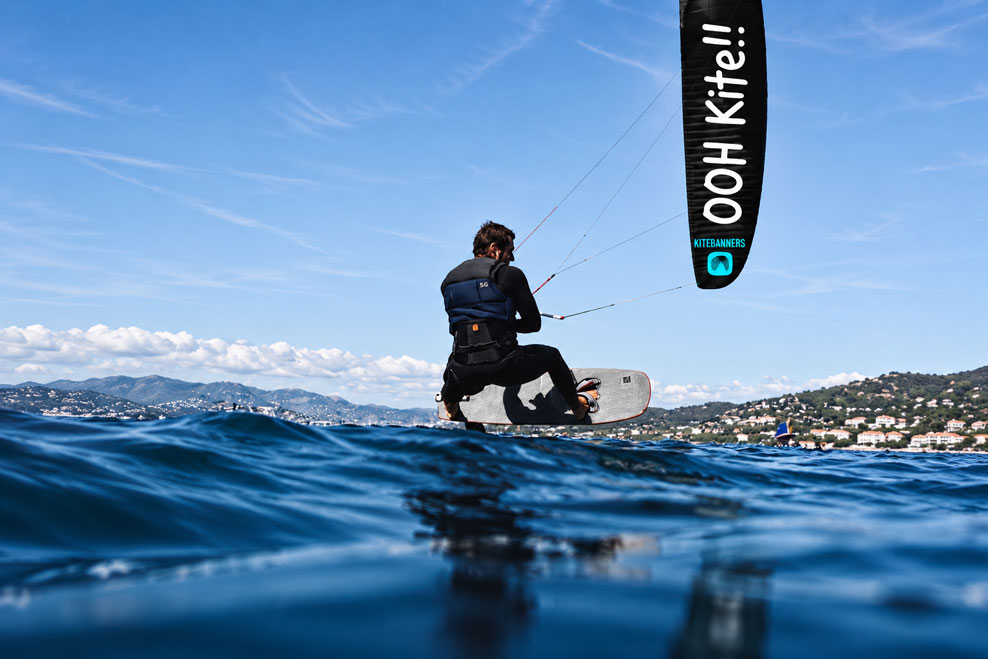
KiteBanners uses large-format branded kites flown by professional kitefoil riders operating offshore, typically 50–150 yards from the beach. Unlike traditional stationary advertising, our kites move dynamically along the coastline, making multiple passes in front of beachgoers throughout each activation. This creates a highly visible, attention-grabbing advertising experience that combines the reach of out-of-home (OOH) media with the excitement of experiential marketing. Each activation targets specific beaches and coastal audiences, delivering repeated brand exposure in a unique, uncluttered environment.
That distinction matters because coastal audiences are unusual among OOH audiences. For example, a commuter passes a roadside billboard in seconds. A beachgoer often stays in roughly the same spot for hours, looking up and out across the water far more than they would on a city street. A display that holds its position above that audience stays in view again and again across a single visit.
What a managed activation includes
KiteBanners runs campaigns as a full service media channel. Depending on the campaign, that can include:
- Planning around the target market and dates
- Creative adaptation for the kite format
- Activation logistics
- Trained operators on site
- Ongoing weather monitoring
- GPS flight tracking
- Activation documentation
- Campaign photography or video
For an agency, that means planning and reporting the activation like other outdoor media instead of treating it as a one off event.
Where the format is strong
Kite banner advertising is about presence at a defined place. That makes them a natural fit for advertisers with a geographic anchor, for example a beachfront hotel, a waterfront restaurant group, or a real estate development near the coast. Festival sites and brand sampling programs on the sand fit as well. Because the operators are physically on the beach, the activation can also line up with street teams, product sampling, or a social content shoot.
Where the format has limits
A stationary display does not cover twenty miles of coastline in an hour. Reaching several beaches means planning several activation points or several days, and every activation depends on wind and site conditions. Kite banners are a poor fit when the only objective is the widest possible linear sweep of a long coastline on a single day.
Kite banners vs. airplane banners on reach, dwell time, and frequency
In general, media planners frame audience delivery through reach and frequency. Applying those ideas to aerial formats takes a little care, because neither format has a standardized audience measurement currency in the way that roadside billboards do. Any honest comparison is directional, and planners should present it that way to clients.
Reach
Compared to kite banners, airplane banners have the edge in raw geographic coverage. A route that runs along a long coastline passes over more total beach area than any single fixed display can. If the campaign brief is “touch as many beaches as possible on Memorial Day weekend,” towing is the more direct tool.
Kite banners, on the other hand, concentrate on a smaller area with a denser audience. On a crowded beach such as a central stretch of Miami Beach or a popular Jersey Shore boardwalk beach, the audience within sight of one display can be substantial. The planning question becomes how many people are within view of a given location and for how long, rather than how many miles a format covers.
Dwell time
This is where the two formats separate most clearly. A towed banner is visible to a given beachgoer for the length of a pass. A kite banner stays in that same person’s field of view for as long as the activation runs and they stay on the beach. For brands whose message needs more than a glance (a new product, a destination, a property, a lifestyle position), longer dwell gives the creative more time to register.
Frequency
With airplane banners, frequency is bought through repeated passes, and each pass is a separate exposure separated by gaps. With kite banners, the display remains up, so a person who looks up several times during a visit encounters the brand again each time. In fact, neither format produces an audited frequency figure on its own. What a planner can document is the schedule: number of passes on one side, hours aloft at a specific location on the other.
A note on audience estimates
Beach attendance data from local governments, lifeguard agencies, and tourism bureaus can help size the audience opportunity for a given beach and date range. Those figures describe how many people were at a location, not how many saw a message. Planners should keep audience opportunity estimates clearly separate from measured outcomes in client reporting, whichever aerial format they buy.
Creative considerations for each format
Creative is where many aerial campaigns win or lose, and the two formats reward different approaches.
Designing for airplane banners
People read towed banners in motion, from far away, often at an angle against a bright sky. The best performers usually carry a very short message, high contrast, and a single action. A brand name plus a short URL or a date works. But a full tagline with a logo, a product shot and legal copy usually does not.
Designing for kite banners
A kite display gives the viewer more time, so the creative can carry a little more brand expression. Strong logo treatment, bold brand color, and a clean visual idea tend to read well against open sky. A short line can work alongside the brand mark, especially when it ties to something happening on the beach that day.
Practical creative guidelines for kite banners
- Prioritize the logo and one visual idea over secondary copy.
- Choose colors with strong contrast against blue sky and against overcast gray.
- Keep any text large enough to read from across a wide beach.
- Plan for photography, since the display will also appear in campaign content and social posts.
Part of the KiteBanners process is adapting existing campaign creative to the kite format, so agencies can bring artwork from a print, DOOH, or social campaign and keep the brand consistent across channels.
Weather, regulations, and operating limits
Every outdoor format has conditions it cannot control. For aerial media, those conditions are more visible, so a good plan addresses them before the insertion order is signed.
Weather
Banner planes need flyable conditions. Low clouds, poor visibility, storms, and strong winds can ground flights or shorten routes. Kite banners need the opposite of calm: they depend on enough wind to stay aloft, and wind that is too strong or too gusty can make flying unsafe. Rain and lightning stop both formats.
The practical takeaway for planners is to agree in advance on how weather is handled. Ask any aerial vendor how they monitor conditions, how they decide when to fly, and how they reschedule or credit a lost day. KiteBanners monitors weather as part of each activation so planning decisions are made with current information rather than at the last minute on the beach.
Federal rules for kites
Federal aviation rules also cover large kites. 14 CFR Part 101, Subpart B sets operating limits for moored balloons and kites. Among other conditions, it restricts flying within five miles of the boundary of any airport and above 500 feet. It also requires notice to the nearest FAA air traffic facility at least 24 hours before flying an unshielded kite more than 150 feet above the surface.
Those rules have a direct planning consequence. Many popular coastal markets sit near commercial and general aviation airports, so the exact activation point matters. Site selection is a regulatory question as much as an audience question, so settle it early in the planning process.
Local rules
Beach access, commercial activity on public sand, and local ordinances vary by city and county. A professional operator should be able to explain how they will permit or coordinate an activation at the proposed location. If a vendor cannot answer that question clearly, that is a risk for the brand and the agency.
Proof of performance and campaign documentation
Media buyers are used to proof of performance in traditional OOH: posting photos, run reports, play logs for DOOH. Hold aerial formats to a similar standard, adjusted for how they work.
What documentation can show
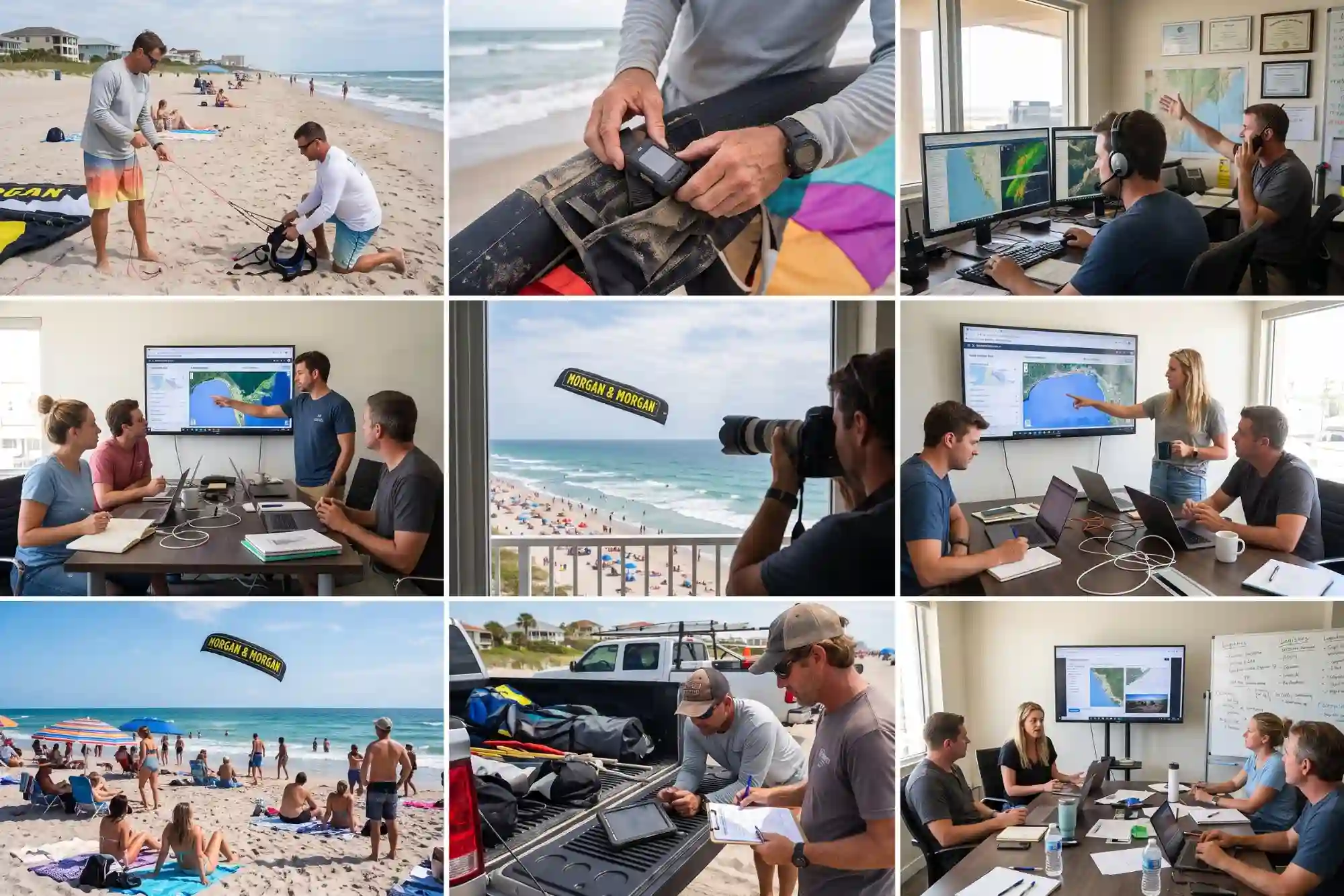
KiteBanners uses GPS flight tracking along with photo and video documentation of each activation. GPS data shows where and when the display was flying, which gives the advertiser and the agency a verifiable record of campaign execution and flight coverage. Photos and video show the creative in place above the beach.
What documentation does not show
However, GPS data does not measure attention, impressions, brand lift, or sales. It confirms that the activation ran as planned. The same limit also applies to flight logs from a banner tow operator. If a campaign needs outcome measurement, plan it separately: brand lift surveys, promo codes or dedicated URLs, foot traffic studies, or social listening tied to the activation dates.
Keeping those layers distinct protects everyone. Execution data, estimated audience opportunity, third party market data, and measured campaign results each answer a different question. Clients make better decisions when reports label them clearly.
Where each format fits in an integrated media plan
Neither aerial format should be planned in isolation, and neither replaces billboards, DOOH, transit, sponsorships, or experiential programs. Both are most effective as a layer that extends a campaign into a setting the rest of the plan does not reach well.
Covering the last stretch of the coastal journey
Roadside and transit OOH, the backbone of most coastal OOH advertising plans, can reach tourists and residents on the way to the coast. But once people walk onto the sand, most traditional outdoor media drops out of view. Coastal OOH fills that gap. A beverage or suncare brand running billboards along a beach corridor can carry the same creative onto the beach itself with a kite activation, so the audience meets the brand again where they spend the day.
Pairing with experiential and sampling
Because kite banners are operated from the beach, they pair well with experiential advertising on the ground. A sampling tent, a brand ambassador team, or a pop up becomes easier to find when a large branded display marks its location from far down the beach.
Feeding social and content
Aerial displays photograph well. Campaign photography and video from a kite activation can feed paid social, organic posts, and recap reels for the client. For destination marketing and event advertising, that content often extends the life of the activation well beyond the day it ran.
Using both formats together
For larger coastal campaigns, the two formats can work side by side. Banner planes, meanwhile, provide the broad coastline sweep on peak days. Kite banners hold priority locations such as the beach in front of a sponsored event, a flagship hotel, or a high traffic stretch near a pier. The RE/MAX campaign with KiteBanners is one example of a brand choosing a stationary aerial presence over the beach as part of its coastal visibility.
How to decide on kite banners vs. airplane banners for your campaign
The fastest way to settle the kite banners vs. airplane banners question is to work through a short set of planning questions with the client.
Questions that point toward airplane banners
- Is the goal broad awareness across many beaches on a single day?
- Can you cut the message to a few words and one action?
- Is the audience spread out along a long coastline with no single priority location?
Questions that point toward kite banners
- Does the brand have a specific place that matters, such as a property, venue, event site, or activation zone?
- Does the creative need more than a glance to land?
- Will the activation tie into sampling, a street team, or a content shoot on the beach?
- Is documented, location specific execution important for client reporting?
What shapes campaign scope and cost
Budget conversations for coastal OOH depend on several variables rather than a single rate. For kite banner advertising, the main factors are:
- The market
- Campaign dates and duration
- How many activation days are planned
- The number of kites
- Creative adaptation and production needs
- Geographic coverage across beaches
- Seasonal timing around events like Spring Break or Art Basel Miami Beach
- The campaign objective
KiteBanners builds proposals around those variables, so the most useful first step is to share the brief and the target markets and request a recommendation built for that campaign.
Advertiser categories that tend to fit
Kite banners tend to suit brands whose audiences spend real time on the coast:
- Hospitality and hotels
- Travel and tourism
- Beverage and alcohol brands
- Suncare and body care
- Sportswear and action sports
- Real estate
- Universities recruiting during Spring Break
- Insurance and financial services in coastal regions
- Entertainment brands promoting events
Planners working in South Florida, coastal California, or the Jersey Shore will recognize most of those categories from their summer and winter season plans.
Planning your next coastal campaign
The choice between kite banners vs. airplane banners comes down to coverage versus presence. Airplane banners move a short message across a long stretch of coastline and suit broad, date driven awareness pushes. Kite banners hold a branded display over a specific beach for hours, which gives creative more time to register and gives location focused campaigns a stronger anchor.
Both formats share real planning considerations. Both formats need a clear weather plan. Federal and local rules shape where each can operate. Documentation should show execution clearly without overstating what it proves. Used well, either one extends an integrated campaign into the coastal environment where most traditional outdoor media stops.
Building a summer, Spring Break, or event campaign where a beach or waterfront location matters? KiteBanners can help you evaluate whether coastal OOH belongs in the plan. Share your markets, dates, and objectives with the KiteBanners team to discuss the opportunity, review campaign formats, and request a campaign recommendation built around your media mix.