
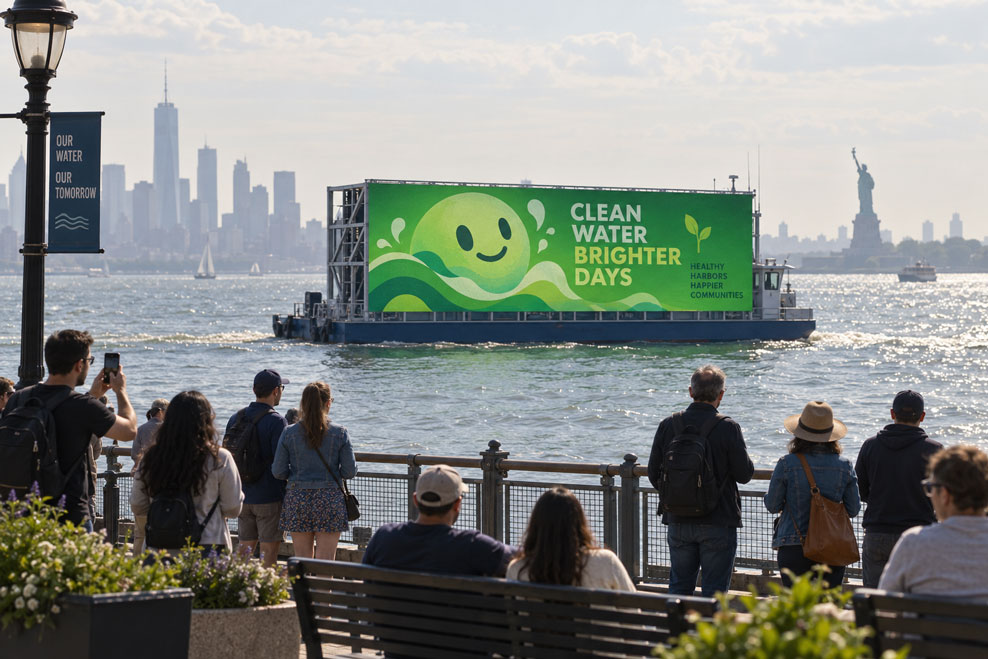
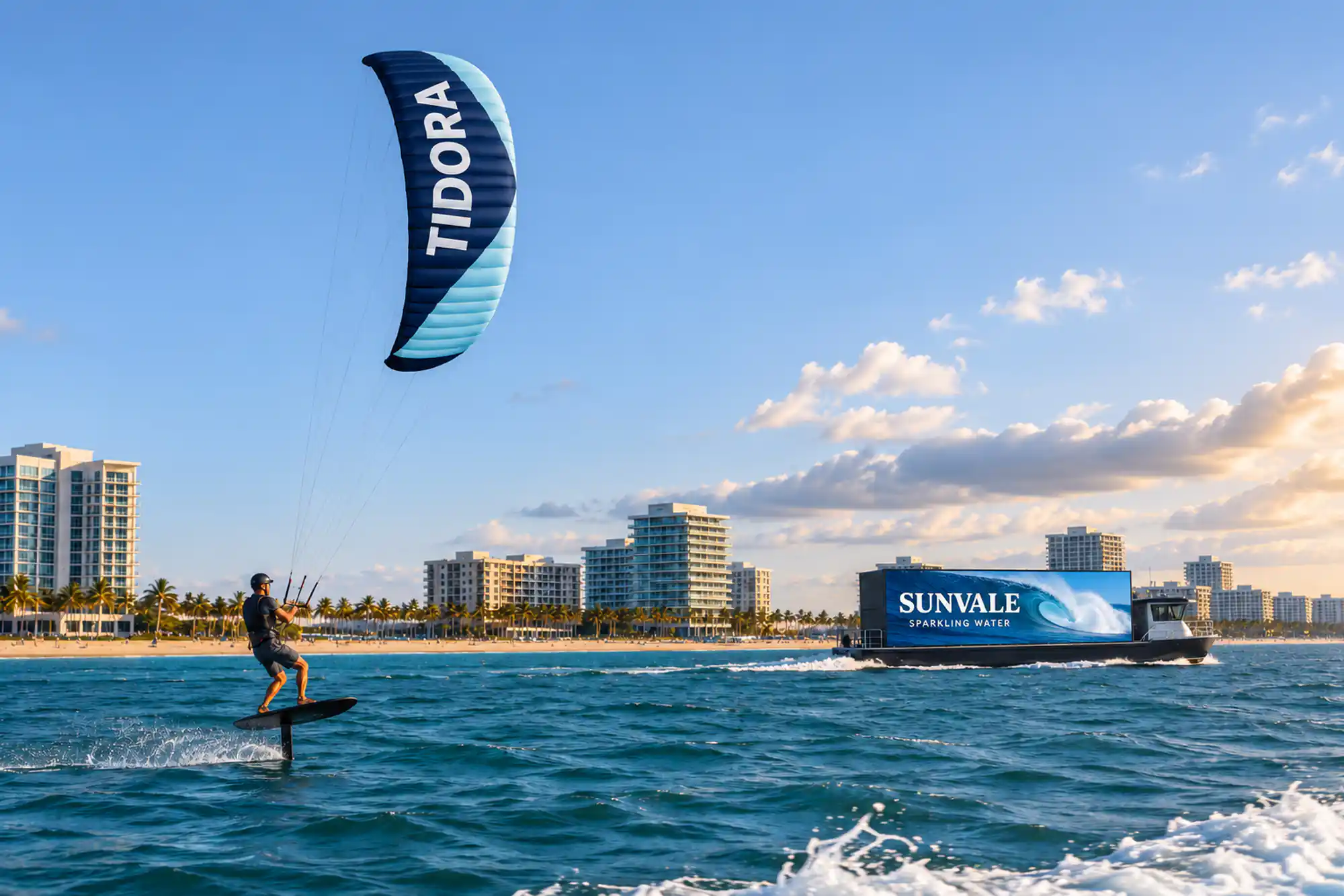
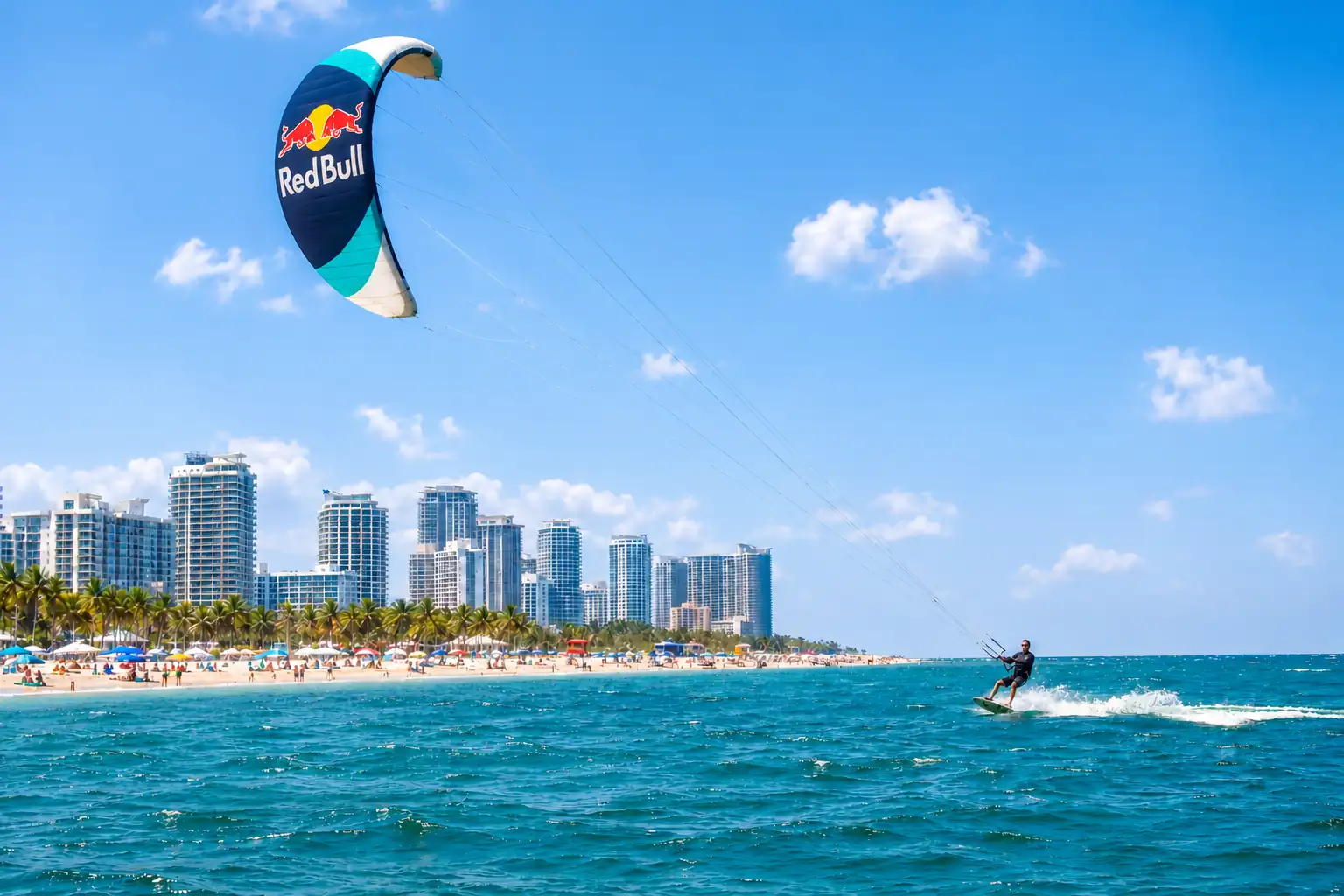
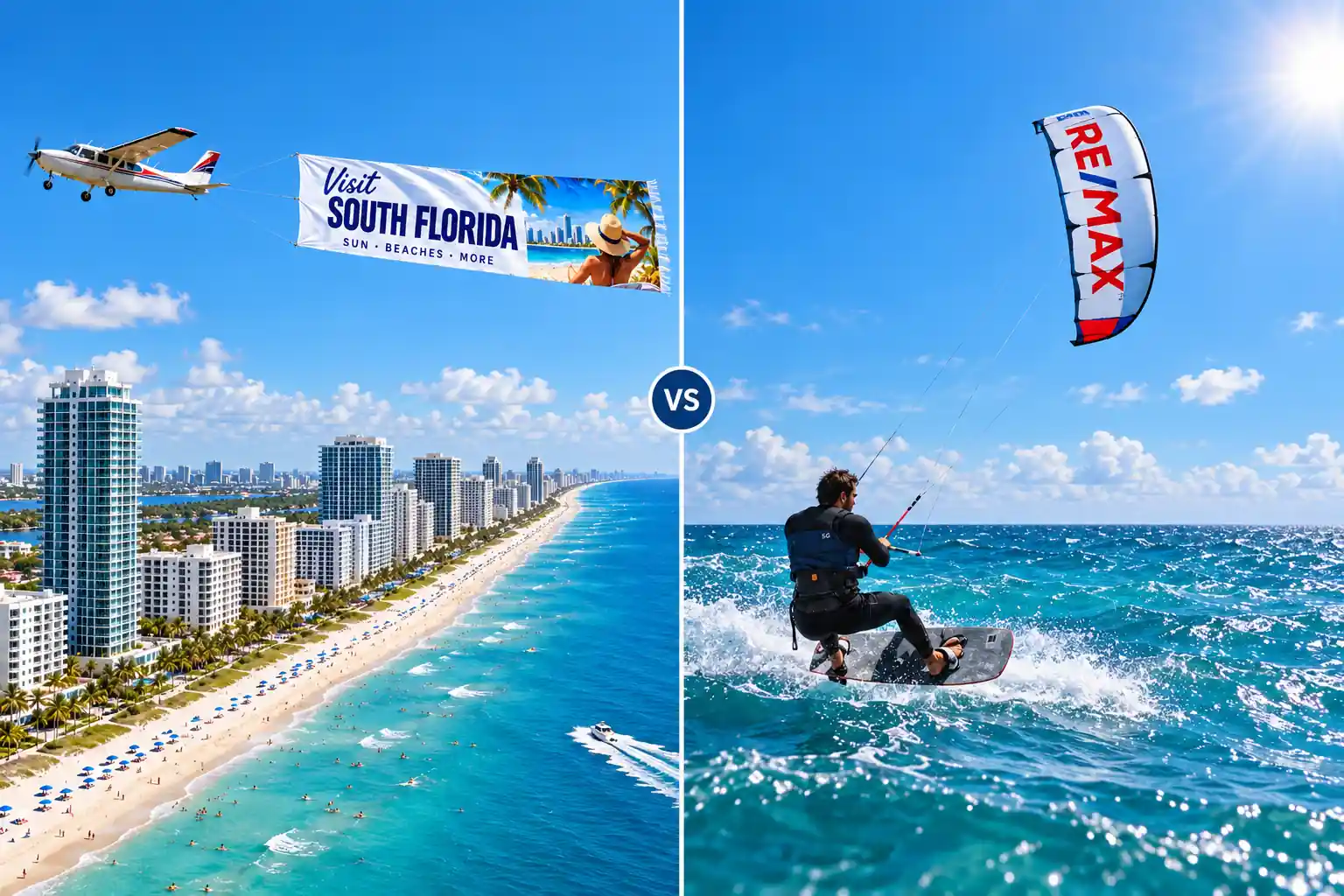
Water based OOH is a growing planning category for brands that want to extend out of home advertising into waterways, beaches, harbors, waterfront districts, and the airspace above coastal audiences. The inventory can include digital billboard boats, ferry and water taxi media, wrapped vessels, sponsorships, floating or waterfront activations, and aerial formats such as kite banner advertising that operate above the water while facing audiences on shore.
A media buyer should not treat these formats as interchangeable novelty media. Each has a different operating model, audience pattern, creative requirement, route, visibility profile, weather sensitivity, and measurement method. The planning discipline is the same one agencies apply to established OOH: define the objective, understand the audience, choose the right geography, verify execution, and explain how the format complements the larger media plan.
This guide provides a practical framework for evaluating advertising on and above the water. It covers the main formats, market selection, route planning, creative, operations, proof of performance, audience measurement, and the questions buyers should ask before recommending water based media to a client.
In This Article:
- What Water Based OOH Means for Media Buyers
- Water Based OOH Formats on and Above the Water
- Why Waterfront Environments Matter to Advertisers
- How to Plan the Market, Route, and Audience
- Creative for Water Based OOH
- Operations, Weather, Permits, and Logistics
- Measurement and Proof for Water Based OOH
- Water Based OOH in an Integrated Media Plan
- Media Buyer Checklist for Water Based OOH
What Water Based OOH Means for Media Buyers
Water based OOH is out of home media that uses waterways, vessels, coastal routes, or water adjacent viewing environments as part of the advertising delivery system. Some formats operate physically on the water. Others operate above the water, positioned so a waterfront audience can view them.
The category belongs within the broader evolution of moving and dynamic OOH. In June 2026, the Out of Home Advertising Association of America released a strategic guide covering transit media, rideshare advertising, vehicle wraps, mobile billboards, waterway media, experiential activations, and other moving formats. OAAA described these media as ways to connect with people as they travel, shop, attend events, and move through communities. Source: OAAA Moving and Dynamic OOH guide.
That industry context is important because waterway media is no longer best understood as an isolated stunt category. A planner can evaluate it within familiar OOH disciplines: audience, geography, route, frequency, creative, proof, measurement, and integration.
Water based does not mean one audience
A harbor commuter on a ferry, a tourist on a waterfront promenade, a family spending the afternoon at the beach, a yacht show visitor, and a hotel guest overlooking the ocean are all coastal consumers, but they represent different planning opportunities. The media format should match the actual audience and behavior.
Water based OOH can solve a coverage problem
Traditional OOH performs well on roads, transit routes, street furniture, shopping areas, and place based networks. But the consumer journey can continue into spaces with less conventional inventory. Water based OOH can help maintain physical brand visibility when audiences move into marinas, beaches, waterfront parks, resort zones, boating corridors, or shoreline events.
Water Based OOH Formats on and Above the Water
The best format depends on where the audience gathers and how the advertiser wants to reach it. Buyers should compare operational characteristics, not just visual impact.
Digital billboard boats
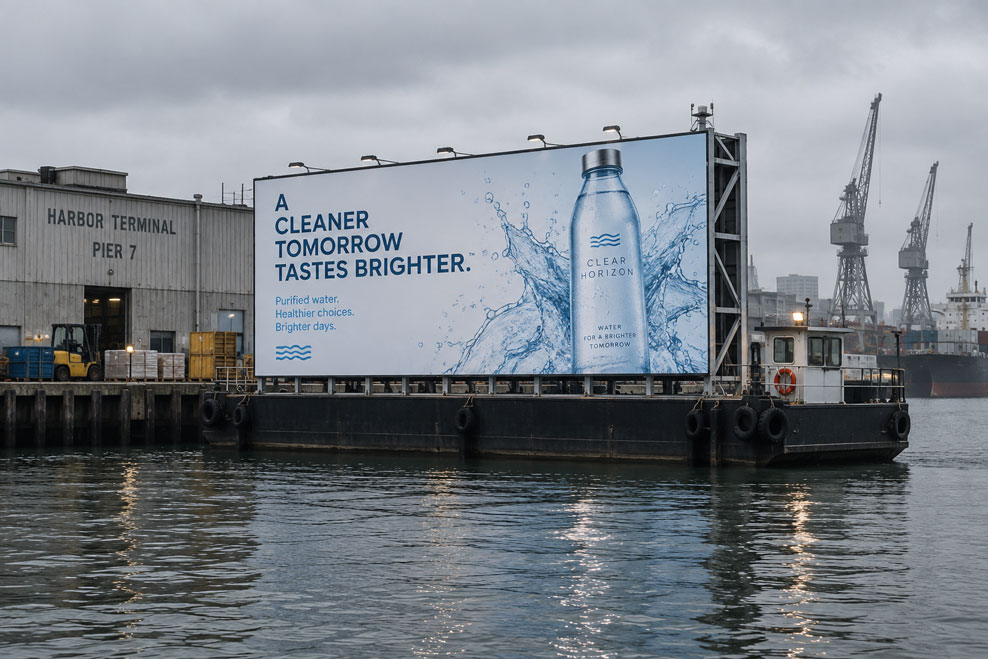
Digital billboard boats carry illuminated displays along waterways. They can support multiple creatives, timed rotations, and high impact visuals. They are often best suited to urban waterfronts, nightlife districts, event zones, marinas, and shorelines with clear sight lines. Buyers should evaluate screen size, brightness, route, dwell areas, viewing distance, operating hours, local restrictions, and reporting.
Ferry and water taxi media
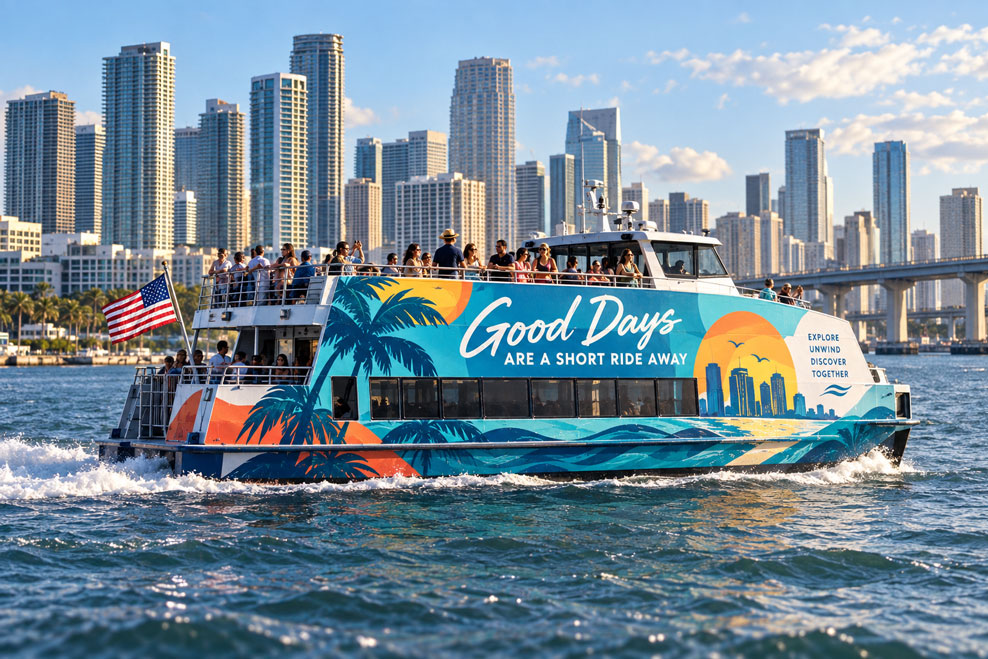
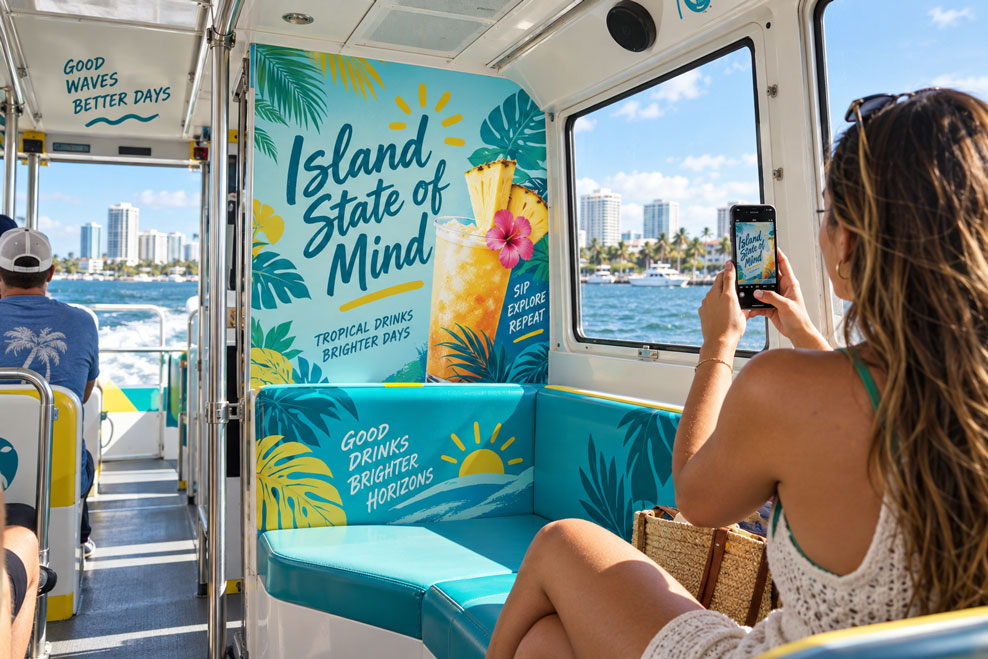
Ferries and water taxis may offer exterior wraps, interior panels, digital screens, terminal inventory, or sponsorship packages. Because they follow established passenger routes, they can behave like transit OOH with recurring rider flows and identifiable origin and destination points. This can make them useful for tourism, commuter, financial, entertainment, retail, and destination campaigns.
Branded vessels and boat wraps
Boat wraps create persistent brand presence on a moving vessel. They can work in marinas, harbors, waterfront event areas, and leisure boating corridors. Production is less flexible than digital media because crews physically install the creative, but the format can provide a large branded canvas and repeated presence during the campaign period.
Kite banner advertising above the water
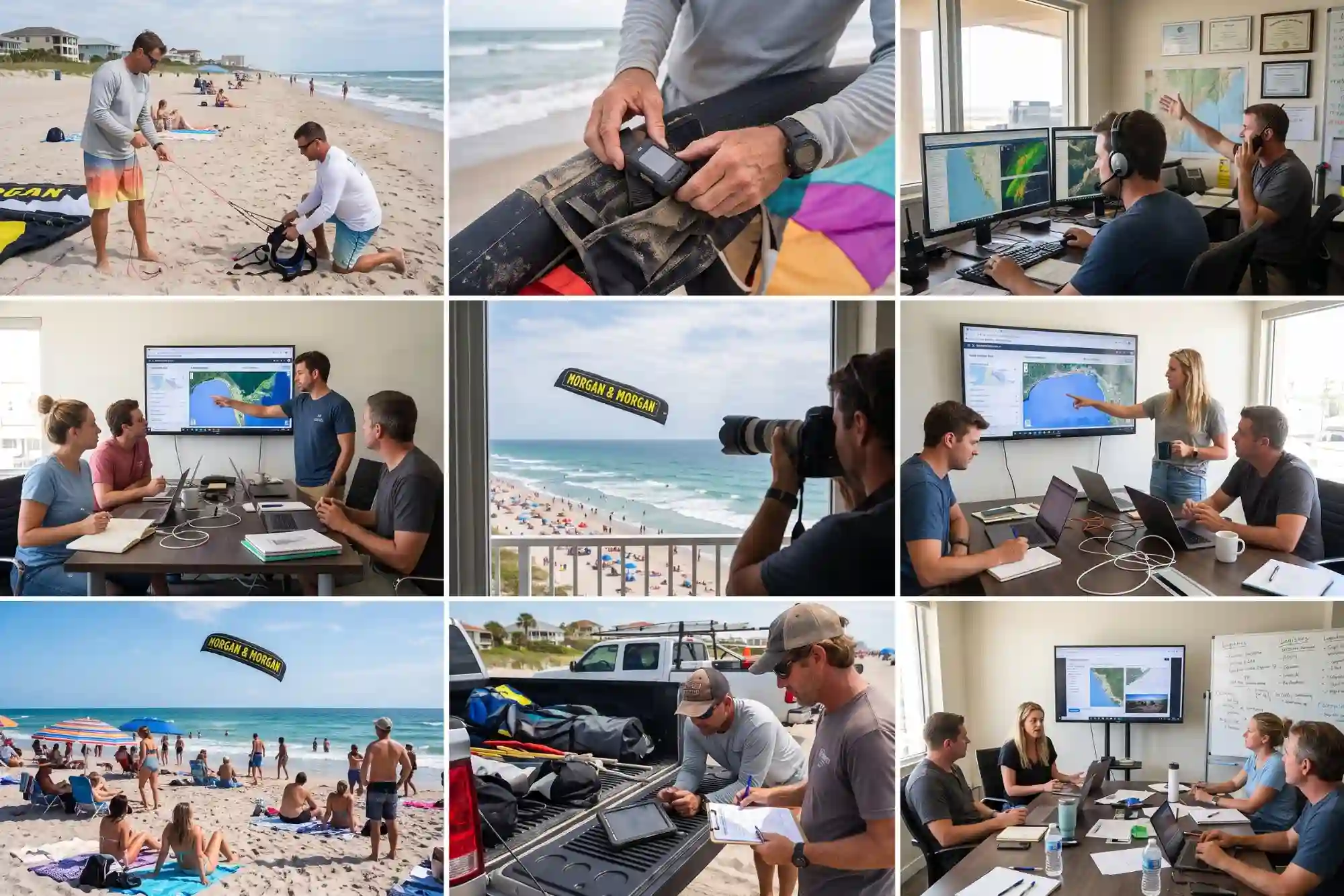
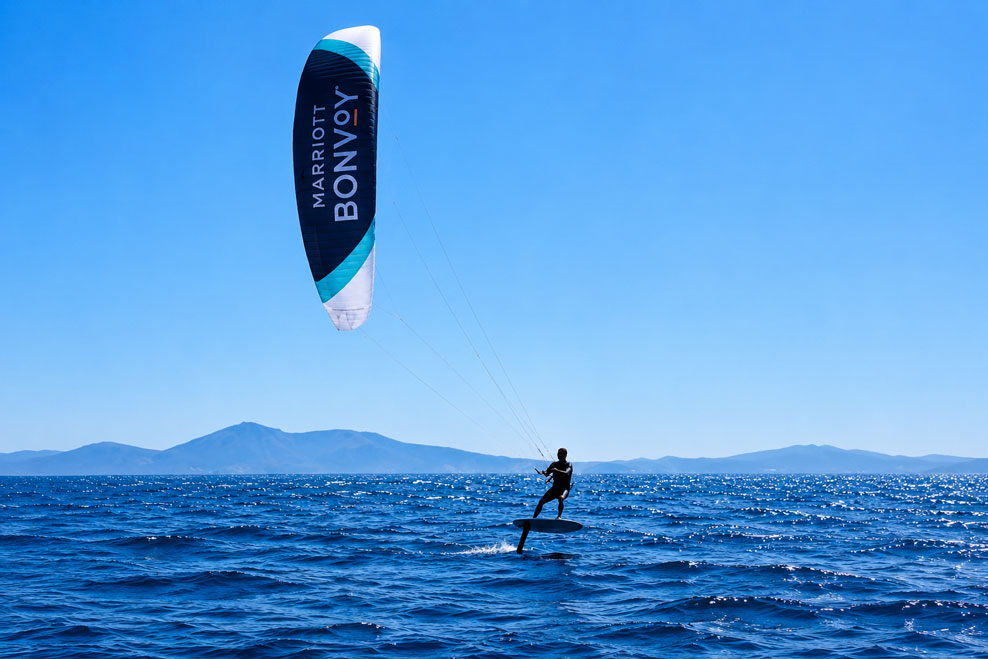
Kite banner advertising operates above the water while facing beach audiences on shore. KiteBanners uses large format branded kites, professional offshore operators, repeated coastal passes, weather monitoring, GPS flight logs, activation summaries, and campaign photography. This makes it a distinct aerial layer within water based OOH, especially when the audience gathers on the beach rather than traveling on a vessel. Source: KiteBanners.
Airplane Banners
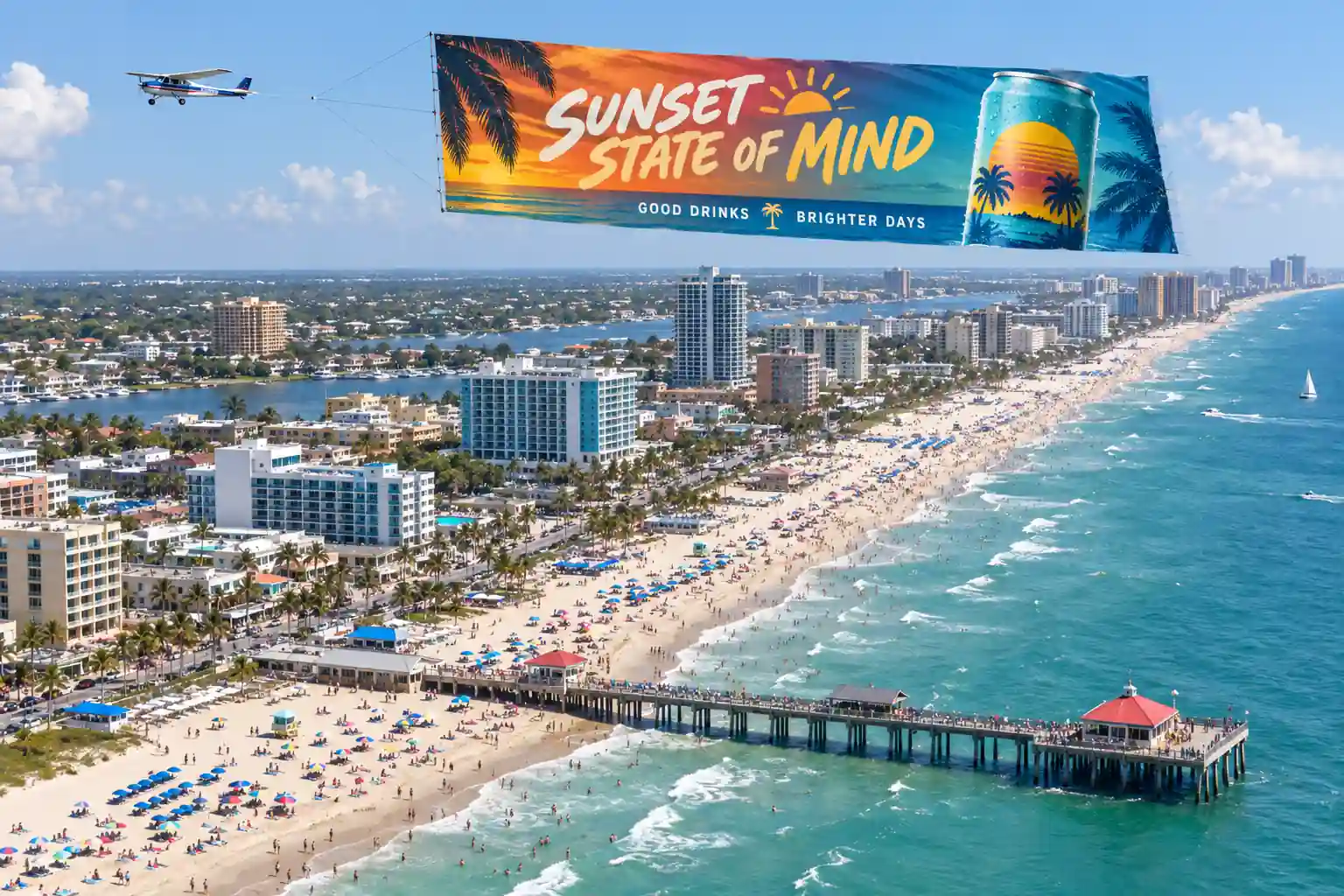
Airplane banners can cover long coastal routes and major beach or event zones. They are a familiar aerial advertising format with different strengths from kite banners. A plane can travel farther during a flight window, while other formats may spend more time within a concentrated zone. The buyer should compare flight path, duration, pass frequency, message size, production, and environmental considerations.
Waterfront sponsorships and experiential media
Boat shows, festivals, races, surf events, waterfront concerts, hospitality programs, marinas, and public events can offer sponsorship and experiential inventory. These opportunities can combine signage, hospitality, sampling, branded structures, content, and direct consumer interaction. Buyers should review the rights package carefully because sponsorship value and media exposure are not always the same thing.
Why Waterfront Environments Matter to Advertisers?
Waterfront environments matter because a significant share of the U.S. population and tourism economy is coastal. NOAA reports that coastal counties are home to almost 40 percent of the U.S. population while representing less than 10 percent of U.S. land area outside Alaska. NOAA’s 2024 Open Economics data also shows that coastal tourism and recreation directly employ more than 2.5 million people and contribute approximately $207 billion in GDP. Sources: NOAA coastal demographics and NOAA coastal tourism and recreation.
Those statistics do not tell a buyer which beach or waterway to purchase. They do establish that coastal environments represent a large consumer and economic landscape rather than a fringe location category.
Leisure context can be strategically useful
Travel, hospitality, beverages, consumer packaged goods, suncare, sportswear, entertainment, automotive, financial services, real estate, and lifestyle brands may have natural reasons to appear in coastal environments. The setting can reinforce the campaign idea because consumers are already engaged in travel, leisure, recreation, dining, events, or destination experiences.
Water can create uncluttered sight lines
Some water based formats benefit from open sight lines and fewer competing structures than dense urban media environments. That can create strong visual presence, but it does not eliminate competition for attention. Consumers are still talking, swimming, walking, boating, eating, taking photos, and using phones. Creative and route quality remain essential.
Coastal audiences can have long destination dwell
A person may stay within a beach or resort district for hours, so a campaign can create recurring exposure across multiple formats and moments. Consumers can see a campaign on the way to the coast, within the waterfront environment, at a hotel or restaurant, and again through mobile or social media. This is where an integrated plan can become more valuable than a single isolated activation.
How to Plan the Market, Route, and Audience
Water based OOH planning should begin with a market map, not a format photo. Identify where the target audience gathers, how people move through the environment, which viewing zones matter, and what route or placement can reach them.
Define the audience precisely
“Waterfront consumers” is too broad. A campaign might target hotel guests, local residents, boat owners, tourists, event attendees, beachgoers, commuters, restaurant patrons, luxury consumers, or families, although these groups may occupy the same market at different times and in different places.
Use geography as a planning variable
Consider shoreline shape, building density, marinas, bridges, public beaches, private resort zones, event venues, boardwalks, ferry terminals, and pedestrian areas. A digital boat route that works in an enclosed urban waterway may not perform the same way on an open coastline. A kite banner campaign intended for beachgoers should prioritize shoreline visibility and audience concentration rather than vessel passenger traffic.
Separate route length from route quality
A longer route does not automatically create more value, since the most useful route may be one that repeatedly covers a dense audience zone, aligns with the event footprint, or reaches several waterfront destinations in sequence. Ask the vendor how they select the route and document route completion.
Plan for season and daypart
Coastal use can change by season, weekday, weekend, holiday, weather, and event calendar. In Florida, VISIT FLORIDA reports that beach or waterfront activities were the leading activity among domestic visitors in 2025, cited by 36 percent. Buyers still need local market data because participation patterns differ by destination. Source: VISIT FLORIDA Research FAQ.
Creative for Water Based OOH
Water based creative needs to account for distance, movement, glare, changing backgrounds, and the amount of time the audience can see the unit. Adapt one creative system to the strengths of each format.
Make the first read immediate
Brand recognition should happen quickly. Use large logos, simple copy, strong contrast, familiar campaign assets, and clear hierarchy. Avoid detailed legal copy, multiple messages, or small calls to action on formats that shore audiences view from a distance.
Design for motion
A moving boat, kite, plane, or wrapped vessel changes position relative to the viewer, so the creative needs to remain legible as angle and distance change. Review designs at realistic scale and ask for format specific mockups.
Use digital flexibility where it exists
Digital boat screens can support creative rotation, event messages, daypart changes, and multiple advertiser executions depending on the network. That flexibility is a strength, but it also requires disciplined sequencing. Too many messages can reduce recall if each appears briefly.
Use multiple aerial units strategically
KiteBanners offers one, two, and three kite configurations. A planner can use those units to create a larger visual footprint or a simple message sequence. The creative should still be understandable quickly and should reinforce the broader campaign identity.
Operations, Weather, Permits, and Logistics
Water based OOH is operational media. Boats need routes and crews. Aerial formats need suitable conditions and trained operators. Events need permissions and production. Waterfront environments can involve local agencies, marine rules, safety zones, weather, tides, wind, visibility, and other constraints.
Ask who owns execution
A full service vendor should clearly explain which party handles permits, staffing, production, route planning, launch timing, weather decisions, communication, and reporting. If several subcontractors take part, the agency should know who is accountable for the final result.
Build a weather plan into the media plan
The insertion order or campaign agreement should address weather sensitivity directly. Define cancellation triggers, communication timing, replacement windows, make goods, and what happens when part of a multi activation schedule cannot run.
KiteBanners states that weather or logistics cancellations roll into a later available window without losing the activation. The company also describes real time weather monitoring as part of campaign operations. Source: KiteBanners FAQ.
Do not confuse flexibility with uncertainty
A professional vendor can acknowledge weather risk while still giving the buyer a clear operating process. The goal is not to guarantee conditions. The goal is to define who makes decisions and how the plan protects campaign value when conditions change.
Measurement and Proof for Water Based OOH
Measurement language should be especially precise in water based OOH because different formats have different levels of standardized audience data.
Execution verification
First, prove that the media ran. Depending on the format, this can include GPS route data, vessel logs, timestamps, photos, video, screen playback records, event documentation, or activation summaries. KiteBanners uses GPS flight paths and campaign imagery to verify flight coverage and execution.
Audience opportunity
Second, estimate who had the opportunity to see the media. Relevant sources may include ferry ridership, tourism data, beach participation, event attendance, hotel occupancy, marina traffic, pedestrian counts, mobile location data, or local population. The vendor should disclose the source and methodology.
Measured exposure and outcomes
Third, determine whether the campaign requires exposure measurement or downstream outcomes such as brand lift, store visits, site traffic, search activity, inquiries, or sales. This can require third party measurement, surveys, matched markets, location analytics, tagged response mechanisms, or other research methods.
GPS alone does not prove consumer attention or business outcomes, because a route file only proves where a unit traveled. This distinction is essential for credible reporting.
OAAA is currently advancing an industry measurement modernization effort designed to improve transparent, comparable, and actionable OOH audience insight. That work reinforces a core buying principle for emerging formats: methodology matters as much as the headline number. Source: OAAA measurement initiative.
Water Based OOH in an Integrated Media Plan
Buyers should position water based OOH as an extension of a broader strategy, not a replacement for established channels. The format is most useful when it reaches a location or moment that the rest of the plan does not cover well.
Billboards can build reach on major roadways. Digital OOH can provide flexible creative across screen networks. Transit can reach commuters. Paid social can provide frequency and targeting. Search can capture demand. Sponsorships can build event association. Experiential programs can create interaction. Water based OOH can maintain physical visibility after the audience enters a waterfront or coastal environment.
Example: hospitality campaign
A hotel group could use airport media to reach arriving travelers, search and social to support consideration, place based media in a tourism district, and water based OOH to create visible presence near the beach or waterfront, so the coastal layer reinforces the destination experience instead of duplicating the airport or digital campaign.
Example: beverage launch
A beverage brand could combine retail media, sampling, creators, paid social, digital OOH, and a coastal activation during a peak travel period. Kite banners or waterway media can add scale and visual presence while sampling creates trial and digital channels capture response.
Think about content as a secondary asset
Many water based executions are visually distinctive. Agencies can plan photography and video for social, public relations, creator programs, sales materials, and recap content. Agencies should scope the content value in advance, with clear usage rights and deliverables, rather than treat it as an automatic substitute for media performance.
Media Buyer Checklist for Water Based OOH
Before recommending water based OOH, media teams should require answers in five areas: audience, geography, creative, operations, and measurement.
Audience
Who is the campaign intended to reach? What data supports the market? Is the audience composed of visitors, residents, passengers, event attendees, or modeled coastal participants? Is the source current?
Geography and route
Where will the unit operate? What are the priority viewing zones? How long will it remain in those areas? Does the route align with the target audience rather than simply maximizing distance?
Creative
What are the size, copy, contrast, animation, sequence, and production requirements? How will the vendor test readability at expected viewing distance?
Operations
Who handles permits, crews, weather decisions, vessel or flight logistics, safety, scheduling, and make goods? What is the escalation process when conditions change?
Measurement
What verifies execution? Which source estimates audience opportunity? Then what measures actual outcomes? Require separate answers and separate methodologies.
Budget
Public rates can be misleading because water based campaign scope varies widely. Cost can depend on market, duration, frequency, number and type of units, creative production, staffing, route, event timing, content capture, and reporting. Request a custom recommendation tied to the brief so buyers can compare competing options on equivalent scope.
Conclusion
Water based OOH gives media buyers a broader toolkit for reaching consumers in beaches, harbors, marinas, ferries, waterfront districts, resort zones, and other coastal environments. The category includes digital boats, passenger vessel media, wrapped boats, sponsorships, experiential activations, airplane banners, and kite banner advertising above the water.
The strongest campaigns treat these formats as professional media inventory. They begin with audience and geography, use creative designed for distance and motion, plan around real operating constraints, document execution, and distinguish audience opportunity from measured outcomes. Water based OOH becomes most valuable when it fills a location gap in an integrated plan and gives a brand a credible presence in a physical environment that matters to the target consumer.
Planning a coastal or water based OOH brief? Explore KiteBanners as an aerial coastal layer within the category. Review the campaign formats, download the KiteBanners info deck, or discuss a market, schedule, creative configuration, and reporting plan with the team before building the format into your media recommendation.